tuxwire: An RSS Reader Built for Note-Taking
I’m a big fan of RSS readers. I like picking and choosing exactly where my news comes from, and RSS is still the best way I know to do that.
Every day I read Linux, FOSS, and kernel news from about 15 different sources. I wanted a way to bring all of them together in one place — so I built tuxwire, a terminal-based RSS reader written in Rust.
The Problem
You’re probably asking, “Why not just use an existing RSS reader?” And I do — I love RSS readers. But even the good ones are missing one feature I rely on constantly: note-taking.
I read a lot of articles with walkthroughs I want to try or apps I want to install. Most of that reading happens on my phone, but most of the content applies to my desktop. Minimizing an article to jump to a separate notes app wastes time and breaks my flow. I’d been doing that for years, and ended up with a sprawling Obsidian vault of scattered notes and around 500 saved article links.
So I decided to build the tool I actually wanted.
Click to view
What It Does
I originally set out to build something just for Linux news. Partway through, I thought: why stop at Linux? So tuxwire grew into a full RSS reader for any feed — Linux news is just my primary use case.
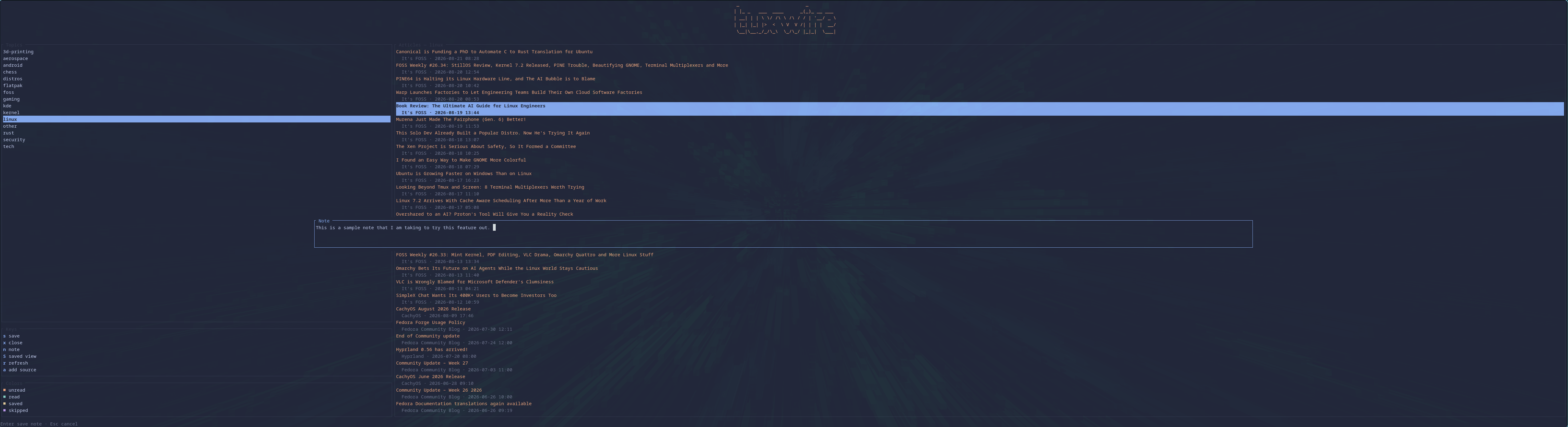
Articles are stored in a local SQLite database, and notes are built directly into the reading flow:
s      save / unsave the current article
n      add or view a note on a saved article
Enter  confirm and save the note
Esc    discard the note
Saved articles are marked with a distinct color so they stand out in the list. Pressing s while browsing shows all your saved articles, with a preview of any note attached. Hit n again to open the full note.
Articles are also color-coded by status — read, saved, or not interested — which makes scanning the list much faster once you’ve got a backlog going.
I originally planned to add a machine learning layer that would learn which articles I tend to skip and start filtering them out automatically. The more I thought about it, though, the more it felt like overkill. Since I’m already curating my sources, there just aren’t that many articles I skip. I scrapped that idea and kept the tool simple.
Built in Rust
tuxwire is written in Rust using ratatui for the TUI, with a Catppuccin Macchiato theme throughout. Because it’s a Rust binary, it also runs on my phone via Termux — same tool, same workflow, whether I’m on my desktop or on the go.
What’s Next
The project is up on my GitHub at shanecuster/tuxwire. It’s currently at a functional v1, and I’m doing some more personal testing before opening it up more broadly for others to use.
I read a ton of FOSS projects built by other people — it feels good to finally have built one of my own.
If you try it, let me know via one of my socials.
Thanks for reading!
Until next time, —Shane